Booking the hostesses is the easy part. Briefing them well is what makes the difference between staff who smile politely and staff who bring you leads. A good brief covers five things: your brand, the venue or stand, the people, the rules and who to call when something goes wrong. Here is how to plan it.
Step 1: Decide the roles and the headcount
Before you book, write down what you need the team to do. Welcome and registration, lead capture, product demonstrations, VIP care or sampling are different jobs. Match the role to the task, then count the posts that must be filled at your busiest time, plus cover for breaks.
Step 2: Follow a briefing timeline
| When | What to cover | Who leads |
|---|---|---|
| 2 to 3 weeks before | Written brief: product summary, goals, shift pattern | You |
| 7 to 10 days before | Final headcount, uniform sizes, badge names, languages | Our coordinator |
| 48 hours before | Product and message briefing, by video call or in person | Your stand or event manager |
| The day before | Walkthrough: stand or room layout, badge pickup, entrances | Our team leader with you |
| Each morning | Short stand-up: targets, VIP visits, changes | Your manager |
Step 3: Write a short brief
Keep it to one or two pages. Include:
- What your company does, in one sentence.
- What the event or stand is for: leads, sign-ups, demos or guest care.
- The five questions guests ask most, with the approved answers.
- Questions the team must pass to your staff instead of answering.
- Dates, shift times, venue, hall and stand number.
- Dress code and who supplies branded pieces.
- One contact number for the day.
Step 4: Split the briefing
You brief the product, the prices and the messages. Nobody outside your company can explain them as well as you. We brief the team on presentation, timings, breaks and logistics. For teams of six or more, a team leader keeps this running on site.
Step 5: Walk the venue
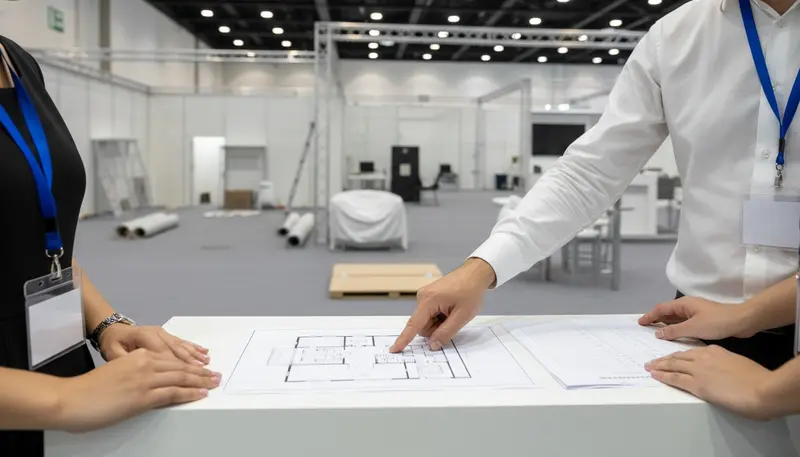
Fifteen minutes on site the day before is worth more than a long document. Show the team the stand or room, the storage area, the lead scanner, the badge desk, the washrooms and the prayer room. Test any app or scanner with them.
Dubai details to plan for
- Dress code. Dubai events expect a polished, modest, business look. Check the exhibitor manual for any rules.
- Badges. Exhibitor staff badges are often collected from a separate point and may need ID copies sent in advance.
- Ramadan. Working hours and breaks can change during Ramadan. Agree the shift pattern early.
- Languages. If many visitors speak Arabic, plan at least one Arabic speaker per shift.
Common mistakes
- Sending a long PDF with no summary.
- Not saying which questions to pass on, so staff guess.
- Changing prices or the layout overnight without updating the brief.
- Skipping the walkthrough.
Ready to book? Send your brief through the contact page, or read about exhibition hostesses first.